bet365亚洲官网

Foam materials are connected or closed porous network structural materials formed by solid materials containing a large number of gas micropores. Foam materials have characteristics such as light material, large specific surface area, high specific strength, sound insulation, heat insulation, and good permeability. Therefore, the processed composite foam materials have wide application prospects in many fields such as microprocessing, adsorption, ammonia storage, catalysis, bioseparation, tissue engineering, biomedicine and environmental protection.
Cellulose has a large amount of reserves in plants and has the advantages of being renewable, widely distributed, low price, strong biocompatibility, and degradable. It is a natural green polymer material. Cellulose nanofibrils obtained after wet milling and high pressure homogenization are good foam reinforcement materials due to their high modulus and strength. Polyvinyl alcohol and graphene oxide are research objects for multipurpose foam materials. Cellulose nanofibrils are used as foam strengthening agents. Cellulose nanofibrillar composite foams can be prepared by freeze-drying.
Instruments and Materials
Wet Mill Labor-Pilot2000/4(IKA)
MiniDeBEE High-Pressure Homogenizer (BEE, USA)
Freeze-Drying Machine Scientz-10N (Ningbo Xinzhi Biotechnology)
High-speed Centrifuge HC2061 (Anhui Zhongke)
Electronic Balance AL204 (Mettler)
Sonic Cleaner KQ2200E (Kunshan Sound Instruments)
Cellulose, polyvinyl alcohol, sodium chloride, chitin (abundant reserves in nature, the effect of using chitin nanofibrils is similar to cellulose) Chitosan natural flake graphite, concentrated sodium nitrate
Experimental methods
Preparation of cellulose nanofibrils: cellulose raw paper is cut and soaked in deionized water, boiled in a boiling water bath for 3 hours to remove surface debris, replaced with deionized water, and placed overnight, and then passed through a wet mill. Grind multiple times. The obtained slurry with small and uniform size was passed through a high-pressure homogenizer for 10 cycles under a pressure of 30000PSI, and finally a uniform and stable cellulose nanofilament suspension was obtained. The raw material chitin powder is dispersed in deionized water, and its nanofibrils are prepared using the same method for mechanical treatment.
The wet milling method and high-pressure homogenization method successfully mechanically defibrillated cellulose and chitin raw materials, and obtained polysaccharide nanofibrils with a diameter of 20-50nm and a length of microns. Cellulose nanofibrillated polyvinyl alcohol composite foams and chitin nanofibrillated graphene oxide composite foams were prepared by freeze-drying method.
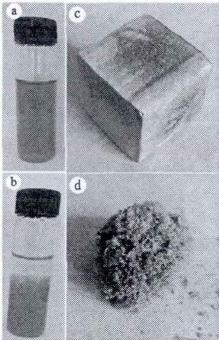
Figure 1. The mixture of graphene oxide-chitin nanofibrils (a/c) and graphene oxide-chitosan nanofibrils (b/d) and foam conclusions after lyophilization
Through experiments such as biochemical degradation, dye adsorption, and foam size monitoring in solution, it was detected that the addition of nanocellulose made this composite foam have higher degradable properties, pollutant adsorption properties and dimensional stability in aqueous solution than the original foam material.